Showing posts with label Family. Show all posts

Thursday, September 20, 2012

Putting the public back in the Republican Party

Right to Left: Robert (my father), and uncles Bill, and Phil in uniform during WWII

 Being good Midwestern Republicans


Both my parents voted Republican in each election as long as I can remember. It was a long history of Republican support, but I wonder how they would feel about the Republican Party these days.

They didn't seem to like FDR personally though they lived most of their early voting lives during the Great Depression and WWII. In later life my father commented that Harry Truman's Presidency was under-appreciated and under-valued. But it's doubtful that he actually voted for him.

My parents "liked" Ike during the 1950s.  I know they voted for Nixon in every election though I imagine they were ultimately disappointed. 

From what I understand, they were "okay" with Ronald Reagan, but I know they didn't think he was a particularly good actor, and I know they didn't think actors should be in politics.  After all, how can you tell if an actor is telling you the truth?

I'm pretty sure they voted for George H.W. Bush, and my mother probably supported George W. after the death of my father. 

More importantly than their voting record, my parents believed in the value of hard work. They believed that people were generally good. But they also believed at everyone needed to look after themselves and their families.

They went to church most every Sunday and were active in their congregation and in civic activities.  They weren't "joiners" or particularly "social", but had a small circle of close friends and respected professional relationships.  Considering that my father was on the road a lot, was an executive of a manufacturing company, the president of his industry association, etc., and that my mother was raising five children, today I find it surprising that they had any social life at all.

They were just good Midwestern Indiana Republicans.

Never ever talk about Politics


I can remember as a child going to the polling station in Michigan City once with my mother.  She showed me the levers of Democracy behind that heavy velvet-like curtain. But she never told me how she was going to vote. She never EVER talked politics. Nor did my father. If a political discussion erupted at the dinner table, they quickly changed the subject.  A person's political beliefs were personal beliefs. 

Politics, in the mindset of my parents, was not a pretty profession.  It wasn't "dirty", but just wasn't pretty.  I don't think they had grand visions about Democracy, but they had an abiding belief that basic fairness was an essential component of the Republican Party they supported. 

They probably would not have voted for Obama in 2008, but they would have embraced his message for the need for change during the financial crisis.  They weren't fans of big government - believing that the best decisions are made nearest the point of action. 

But they did, in fact, believe in Public Service.

My mother worked in an organization called Service League for many years.  My father was an official of his church. They regularly contributed to charities and local service organizations. 

They had a clear personal understanding of what one's behavior should be in public, and politics wasn't a part of that.

During their lives the tradition of Republican Party seemed their natural affiliation. It fit their understanding of who they were, where their traditions connected, and where their future was headed.  You could be a Republican in public, but you couldn't expose your deeply held beliefs in that arena.  Those beliefs may have animated your Republicanism, but not your public persona.

All the elements of the Republican Party my parents subscribed to now seem long gone.

The 47 Percent  

Mitt Romney has said that the 47 percent of Americans:

who pay no income taxes are people who are dependent upon government, who believe that they are victims, who believe the government has a responsibility to care for them, who believe that they are entitled to health care, to food, to housing, to you-name-it.

He also said:

My job is not to worry about those people. I’ll never convince them that they should take personal responsibility and care for their lives.

During the Vietnam War I once asked my father what he thought the US should do. I was astounded by his answer.

"I think we should load up planes with food and doctors and engineers," he said. "Most of those people are just hungry. They have no hope. We need to give them what they need to find hope."

This morning I mentally contrasted this statement of a good Indiana Republican with Mitt's remarks.

I don't think he would recognize the Republican Party of Mitt Romney, nor the beliefs (whatever they might be) of the Tea Party Movement.

Putting the Public back in Republicanism

Maybe Ideology is the difference between a person with "a heart of gold", and a person with a heart made entirely of gold.

My parents grew up during the Depression. They helped to win a world war.  They supported the public institutions and the workers who did the day-to-day tasks that made institutions worth while.  They supported the troops and the veterans of wars.  They supported the values that maintained the public in our republic.

The Republican Party -- as represented by Congress and the Senate and the Mitt Romney campaign and the Tea Party factions -- has transformed what it means to be a Republican.

I'm guessing that - were my parents still alive today -- they could not support the goals or the candidates that are represented by this party of the 1%.  I'm guessing they would long for the days when the word Public had real meaning in the Republican Party. 

Sunday, October 12, 2008

"Deer Fire" in Deer Park Almost Takes Our Home.

On Friday we were evacuated from our house because a fire was running along the ridge behind us.


About ten minutes after the fire started, I shot this photo from the Foothills School.


Helicopters and airplanes were dumping lots of water onto the flames.


Firetrucks and bulldozers were at our corner, and they cut a fire-break through the vineyard at the end of our road. We were evacuated when it was clear that the flames were only a few blocks from the houses.

The flames were forty feet or more and one family's house was lost. The fire had been started by a car that hit a rock and sparked a flame. In less than five minutes it was out of control, fanned by Santa Ana winds.

I had gone down town for just a quick errand and everything seemed fine. But 20 minutes later, coming back up the hill the plume of smoke was enormous.

CBS came to report the event:

We were really lucky, and we really appreciate all the fire professionals and the Sheriff's Department for working so hard to keep us safe. Thanks to Yoda - who fought the fire. Free beer for him when he comes by!

And many thanks to Linda and Tom Shiebal for putting us up, and to Susan Shay for reading us Dylan Thomas during the conflagration. (I think there's a poem in here somewhere).

It's good to be back home tonight. The fire is now contained and even the smoke is down. We have another fire going on here tonight, but fortunately for us, it's in our fireplace.

Saturday, August 16, 2008

Sweatin' the Fundraiser

Tobias today, talking to his computer, worrying about how much needs to be done.

Friday, November 17, 2006

Explosive Tonga -- Volcanos and Riots and Democracy

For about six years now I've been kidded by my friends and family about Tonga. I was depressed with the outcome of the 2000 elections; about the rigged votes; about 9/11; about the lies and missed opportunities leading up to the invasion of Iraq; about the destruction; about the moral hypocrisy that seemed to be coming from an unelected administration bent upon consolidating its power.

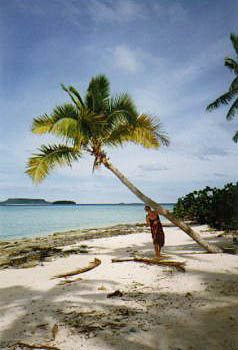
I was immersed in books that recorded the world travels of past generations of sailors, actively seeking a safe haven where corruption, where it occurred, was on more on a scale of human failings than institutional decay. Scale, beauty, simplicity, safety, and humanity: These were the goals. More and more, I found my mind turning to descriptions of the island kingdom of Tonga.

I'd complain and quip about what was going on this country, and eventually people would ask: So what are you going to do about it?

"I want to move to Tonga!" became my response.

Tonga! Tonga! The dream of an island kingdom in the South Pacific! Lots of sailing! Beautiful people! Simplicity! Life! Maybe another chance for happiness!

I'd laugh at myself, along with everyone else, but once inoculated with the idea, the dream seemed to take on a life off its own.

"I'm a writer! I can work anywhere!"

"So where do you want to be?"

"Tonga, maybe! I think we should move to Tonga!"

Meanwhile, Tobias came back from Europe and started college in Pennsylvania. Arwen tried Pennsylvania and returned to California with me. Dagan meandered between Northern California, Southern California, and Oregon. Judith was teaching in Pennsylvania. I felt like I was holding down the fort in St. Helena while the world was collapsing around me.

"Tonga, maybe!" I kept saying to myself. "Maybe in Tonga I can figure all this crap out!"

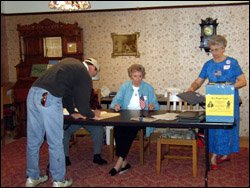
By the time the 2004 elections arrived, my disgust with the direction things were moving here had reached a new low. "When are people going to finally wake up?" I demanded. I had done a little election work in Pennsylvania, acting as an election observer at the polls: Helping to roll in the huge, ancient polling machines; helping people with instructions before they entered into their booths; checking peoples' names off of election rolls; helping to tabulate ballots off the continuous-roll ballot machines; cross-checking the results; talking with the volunteer election officials at the little church where I was stationed.

I began to see the election process in the U.S. as an embodiment of those ancient gray machines with their faded black-velvet curtains and their worn, painted levers -- rows and rows of levers aligned into columns of parties, candidates, issues, and initiatives. And the election volunteers themselves, so happy to have someone new to help them out in the basement of that little brick church. They were lovely elderly people from the neighborhood, gray themselves like the old mechanical machines, and slightly frayed at the edges like the velvet curtains. Blue-haired old ladies directed by an earnest old man. Even I, nearing retirement age, seemed young to them. They were as old as the balloting machines themselves, and it seemed that in their eyes they were looking to me, with a bit of hope, that I might take up their work at the next election.

"Tonga!" my heart murmured in denial. "Tonga!"

One of the balloting machines became stuck. It jammed in the middle of someone's vote-casting. It was stuck solid, and the master lever could not be budged. "No problem!" said the elderly man in charge of the precinct. He moved the voter to another machine, and then -- with my help -- we rolled the broken machine aside, opened the back through a set of shiny polished spring-mounted screws, breaking the metal election seal. He could not do it alone, not because the machine was too heavy, but because I was to act as a sworn witness to what he was about to do.

The back of the machine opened downward to reveal the continuous roll of paper, pre-printed with names of candidates, party affiliations, and ballot initiatives for local and county issues. The recordings of each person's vote had been marked like mechanical chicken marks on the roll as the master lever had been pulled. Each vote, a series of punches permanently imprinted beside each candidate.

As I looked into the mechanism of this machine, with its cogs and levers, I felt as though I were looking into brain of the democracy itself: Heavy, technologically ancient, complex, adequately oiled and cleaned, but worn by sixty years of occasional intense usage. It was an artifact of an industrial age that had long since been surpassed by electronics, but still it persisted to stand. I was faced with the fragility of that democracy, yet chastened by the intensity with which the election official performed his volunteer tasks.

"These machines are older than I am," he said as he drew a line through the spoiled ballot on the machine. "Sometimes they just jam like this, and all you can do is mark where the last ballot ended. He pulled out his clipboard and had me read off the dial of numbers in that indicated how many ballots had been cast on the machine that day. 321 ballots! Then he had me read off the number of ballots that had ever been cast by the machine in its lifetime. I don't remember the number, it was so large. He had me read off these numbers three times, marking them down on his clipboard. Then he signed the clipboard, made a note on the huge roll of paper, signed the roll, had me sign his clipboard, and recorded the date and the time. Then we closed up the massive machine and, together, we rolled it out and down the hallway by the stairs.

"Tonga!" my heart murmured. But the sound of it was a little fainter, a little less intense, a bit like an echo of a desire.

Later, as we closed up the polling place, I thanked the poll workers for the experience. It had been a long night, reading off the numbers off the balloting machine, calling the numbers back and forth, checking and cross-checking each others' work. We had formed a kind of team, and we made little quips about what we were doing as we worked. No one spoke of politics. This was just another job, like raking the leaves or straightening the folding chairs into rows at the end of a church social. We were straightening up after a national election like we were straightening up after a dance. It was a strange sort of dance, indeed. But we were tired. Some of the blue-haired poll workers had been there all day, and they were hungry. I'd been there no more than three hours. I said goodnight and walked out into the rainy darkness and drove to Judith's house.

"Tonga?" my heart now seemed to be questioning me. "Tonga?"

That night my desired Presidential candidate, John Kerry, took the county and ultimately the state of Pennsylvania. I had not voted in that polling place where I worked. I knew I would probably never see those poll workers again. Their looks seemed to be asking for someone new to pass the baton of electioneering, but I knew it would not be me who picked it up. Still, I was humbled by their dedication to an idea about democracy; chastened by their matter-of-fact belief in the process; awed by their persistence to "get it right", "double-check it", "Did you get that number Gladys?" It was like watching my parents do the dishes together so long ago: Doing the dishes of an election.

Tonight I read the news from Tonga on the Internet.

In Se
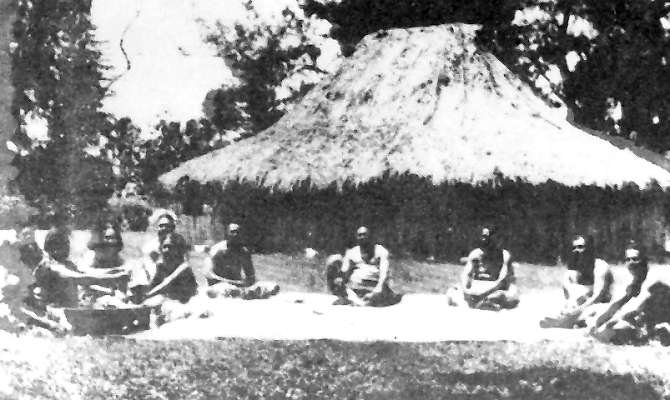
ptember, King Taufa’ahau Tupou IV died at the age of 88. The royal family was just completing the traditional period of 100 days of morning. To mark the official ending of the 100 days of mourning period for the Royal Family the Lanu Kilikili ritual or the Washing of the Stones will be held at the Royal Tomb at Mala’ekula, Nuku’alofa to be carried out by the Ha’a Tufunga. The newspaper said that they have just started receiving the fine stones that have been carefully selected from the shores of the volcanic island of Tofua.

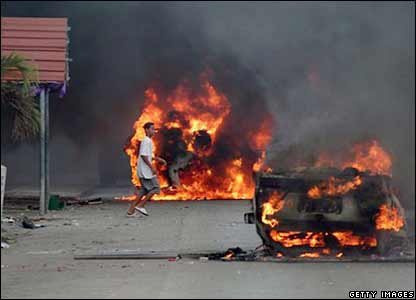
But then, last Wednesday a riot broke out as some drunken teenagers got hyped up after a pro-democracy protest that had been going on all week in front of the new king's administration office.

Cars were overturned. Grocery stores were ravaged. Windows were broken. Fires were set. Fortunately, no one was killed.

If you're interested in my double life in Tonga, you should check out this story at Matangi Tonga Online.

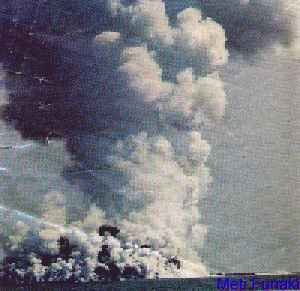
It's clearly been a tumultuous time for the Tongan people. In another story on the newspaper, a new volcano is breaking the surface of the ocean in the Kingdo
m of Tonga. Huge rafts of floating pumice clogged the engines of boat that was the first to actually witness the erupting volcano.

In other news, the electrical utility in Tonga has created a big stir. The electrical utility had been privatized a couple of years ago, but now wanted the government to buy back the assets. The price of diesel fuel to run the generators had ruined the profitability of the company, and it was threatening to sell the assets to Chinese interests. Instead, it was decided to sell the power company to a New Zealand firm. There's still some legal issue about whether the original privatization was constitutional to begin with.

All this is sound
ing hauntingly familiar.

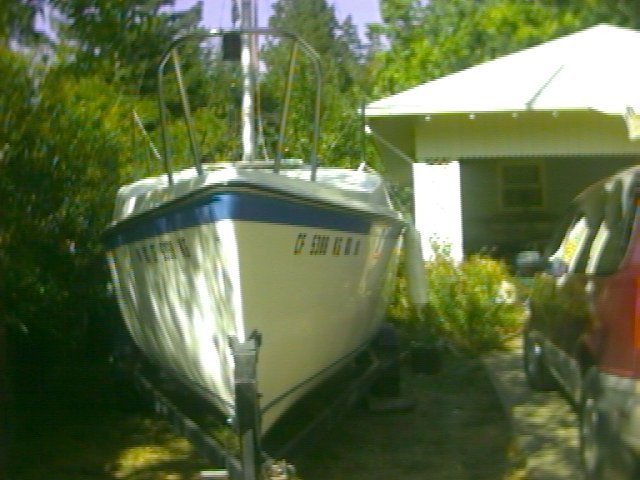
....my sail boat has been sitting on its trailer for a year. Judith thinks I should sell it and get a smaller boat. I don't know.... (...."Tonga!... Tonga!... Tonga!...)


I miss Tonga, having never ever set foot on the tiny island. I miss the Tongan people, having never met a single one. I miss the ceremonies, the island winds, the coral beaches and the palms. My heart still calls out "Tonga!" and I worry about their riot, their volcano, and their electricity.

But here, in Northern California, the leaves are blowing off the trees and the grape vines. It is time for Thanksgiving, after an important election. Tobias is in Cambodia now, but Arwen and Dagan and Kellie and Judith will all be at the dinner table.

The volcanoes are silent in my heart. The riots have been, for the moment, silenced.

I think I'll pour a glass of wine at the Thanksgiving dinner table and propose a toast.

"To Tobias and Tonga!" I'll say.

And, of course, everyone will kid me.

But I think I'll be okay now.

Friday, November 10, 2006

Skyping Tobias in Cambodia

I sometimes am lucky to catch Tobias on Skype, late at night, right before I send my computer to sleep. Last night was one of those times. Tobias is currently in the area of Seam Reap, Cambodia -- which is where the temples of Angkor Wat were built. He's been there, off and on, for almost three years now, working on an interesting project to build an agricultural dam for the people there. How he became interested in this area and involved in this project is documented at his Web site humantranslation.org and the particular story is kind of a parable for how younger people engage the world. You should probably read this story at:


What's become even more interesting, to me personally, is how I'm responding to his project. There was a time, immediately after his first return from Cambodia, when I was very skeptical of his experience. And, to be honest, listening to his stories about his travels and the people he's met, I was probably a bit jealous of his adventures. He had recently graduated from college, had no particular plans in mind, was not immediately involved in any long-term relationships, and was as wide-eyed about the world as most people his age. I kept kidding him that his bedroom was in worse shape than many third-world countries, and he laughed at that analogy. But then, over time, I started to watch him pull things together.

You know how it is, I'm sure. It's like when you happen upon an accide
nt in the middle of the street. You're pulled in multiple emotional directions: Do you stop? Do you help? Do you go for help? Where do you go for help? How do get the help? How do you get the help to the victims?

Or do you turn away? Do you try to put it out of your mind? Do you say to yourself "I really wasn't equipted to help!"? Or "That's someone else's job!"?

I was deeply interested in how Tobias would deal with this particular problem of Seam Reap and the requests of the people for help. How would he sustain his focus? Would he sustain focus?

All these are questions of a father, watching his son move into the responsibilities of adult-hood. And so his journ
ey has become a sort of parable for me too, trying to stay in contact when he is half a world away.

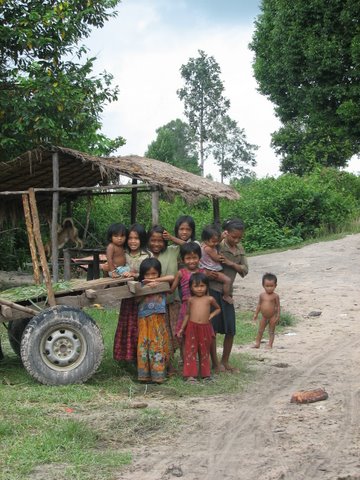
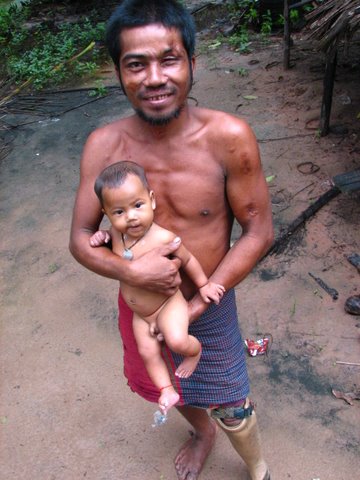
And then, there are the pictures that he sends back: Haunting pictures of ki
ds like these.

This morning, I showed these pictures today to Merriella who comes every week to clean the house. Merriella is from Mexico -- (Yes! She is a US Citizen, in case you're wondering.) She's known Tobias since he was called Toby in highschool, and many is the time I've asked her to help me clean up his bedroom. So she asks what he is doing. And I do my best to explain it to her, but finally just show her the pictures. And she says "These very very poor people! So poor!"

And of course it's true. Then she says "It is good that we send money to help these poor people!"

And I say "Actually, I sent them my son." and she laughs.

Then I look again at the pictures, and here is a young man, holding his own son up proudly to the camera -- his prosthetic leg (his own leg blown off by a mine?) just barely in the picture, and scars on his face, and his little boy naked ....

Can you blame him for looking so proud?


So anyway, what is Tobias up to?

  • He's managed to incorporate his work into an organization (HumanTranslation.Org) and obtained legal help to turn it into a non-profit corporation with tax-exempt status. (Not a trivial task, in and of itself).
  • So far, his organization called HumanTranslation.org has raised about $25K of the $50K estimated to build the agricultural dam that will irrigate a second crop of rice for about 5K people. This money has been kept aside and ear-marked solely for the dam project and assorted water infrastructural projects. A lot of help has come from the Orange Kids network.
  • He's found another good person, named Will Haynes, from Chicago, to volunteer his time over in Cambodia and help in the project. Will wrote a great intro to his own experience that can be read at "Field Report: Words from Will".
  • He's managed to get a small promotional film started, which has appeared on YouTube, which you can view here!


  • They're going to start digging the dam soon, having obtained engineering help from Engineers Without Borders.
  • They've made some sort of arrangement with a water filter manufacturer back here in the US to provide reverse-osmosis (I think) filters for villagers (the orange box in the top picture is one of over 40 installed so far.)
  • He's planning to return to the states at Christmas time to try to raise more funds.
  • He's currently trying to help orphans who live in a Buddhist pagoda with an outbreak of scabies (that's what we skyped about last night.)
  • He's living off his scant savings with no health-care himself.
  • Seems to be in good spirits, but has no time to write about them right now.

So, that's why I'm posting this somewhat nostalgic message, I guess. Tobias is really out in the world, on his own, making his way. Yes I'm jealous of his adventures! Of course, as a father, I'm proud of what he's accomplished so far! Sure, I'm still skeptical that he'll get it all done -- but there is so much to do! But he's doing something! So how can I criticize, sitting here.

And, finally, he sends his congratulations back to the U.S. to all of us who were involved in the elections. All this, Skyping Tobias in Cambodia late at night.

So what am I gonna do?

I'm going to go clean up his room!