Tuesday, January 15, 2013

Honey and the Mason Jar Sieve

A colony dies in N. California

A colony of my bees didn't make it this winter, so I've begun pulling out the honey they made. 

Why did the bees die?

A number of factors, not the least of which we had a lot of rain in late November and December with chilly temperatures. 

Bees need to get out and fly every couple of days to purge themselves, but they can only do that if the temperature rises above 50 degrees.  Then too, these colonies were somewhat weak going into the fall.  They had two "brood supers" (the big boxes where the queen lays her eggs) of stored honey, but they ended up eating out some of the frames and getting into a frame corner, and they didn't have enough heat to stay warm.  So they starved themselves and then got too cold.  Sad! But that's what happened.  I found the queen and a small circle of attending bees surrounding her, dead in a corner of a frame.
Queen and attending bees had food. But they were just too cold.
So, anyway, a few dead bees and a lot of unused honey. What to do?

 Pulling honey without an extractor

I don't own a honey extractor - the one I had back in Indiana was auctioned off when I left there 30 years ago.  It was the old six frame extractor that I picked up at an auction, and I had never used it.  It was made out of galvanized steel anyway, so it was no big loss.
 
So I've been pulling honey for a couple of years now without an extractor, one frame at a time.  Here's what I use:

Bill of Materials

  • Plastic foundation in all the hive frames.
  • Very large stainless steel bowl.
  • Large stainless cooking spoon.
  • Rubber (or sometimes wooden) spatula.
  • Four empty wide-mouth quart mason jars.
  • Six wide-mouth mason jar rings.
  • Four lids.
  • A bit of new, fiberglass window screen.
  • Scissors.
  • Duct-tape.
  • Plastic straws
Simple Mason Jar Sieve for straining honey from comb

Here's what I do:

  1. The plastic foundation allows me to scrape out the honey and wax - down to the foundation - without re-wiring the frames each year. The bees will rebuild the comb as they bring in new nectar. (Not very efficient for the bees, but they're cheap labor.)
  2. Normally I pull out one frame at a time from the colony, brushing off any bees, and bring it into the house.
  3. Scrape the honey and wax into the large stainless bowl using a stainless spoon until I have cleaned the frame down.  I use the rubber spatula to get as much honey off the frame as possible, and then rise the excess off with hot water.  Then I return the frame back to the colony. (In the current situation, back to the empty super.)
  4. I chop up the honey comb as much as possible with the spoon, and then ladle the mess into two quart-sized mason jars.  One deep frame of honey with wax seems to just fill two quart jars, but sometimes it goes to three.
  5. I take two mason jar rings and duct-taped them "top-to-top" so I have a single band that can hold two jars, mouth-to-mouth.
  6. A piece of fiberglass window screen is traced with the mason jar lid. I cut the screen in a circle that fits exactly inside of one of the duct-taped rings.
  7. I put the taped rings (with the screen) onto the jar containing the honey comb so that the screen is honey-side in the ring.
  8. I insert an empty mason jar into the top of the ring and then turn the whole thing upside down.
The honey drizzles down into the empty mason jar and that's about it.

The only problem with this technique is that as the honey drizzles down, it creates a suction in the top mason jar.  Placing the jars at an angle will allow the air in the bottom mason jar to move as a bubble to the top of the top jar.  This gets things going pretty well: I use the cleaned up stainless bowl for this purpose to act as a stand.  Two jars, bottom-to-bottom leaning against the rim of the bowl. It's a little wobbly with just two jars in it, but it works okay. If I'm doing two frames at a time, it's a little tricky, but as I said, it's a big stainless bowl.

Still, eventually I'll end up with a wax/honey plug that is against the screen that slows the drizzle.  So, if the mixture is really thick, I'll open the top jar and push and "smoosh" the wax along the inside glass with the spoon, and then insert a straw behind the screen - reaching to the top of the top jar containing the honey and wax combo. The straw then allows enough air to seep into the top jar and keep the mixture draining.

The process takes a couple of days, and I keep fiddling with it until all the honey is out of the comb. This is a work in progress, and I am still working on the details of the easiest way to set this whole rig going.

When I figure I've got as much honey out of the wax as I can, I simply disassemble the filled jar, put a lid on it with a new ring, and put it into the pantry.

I run hot water into the remaining jar with the screen and the wax - washing the wax until it's sort of granulated.  When the wax no longer has any honey on it I dry the wax between paper towels, and then put it into a plastic bag for a later time when I have enough to melt down in a homemade solar extractor.

The entire process, as I said, takes a couple of days, but the amount of time I'm actually working is usually pretty small - maybe 15-20 minutes per frame if I'm focused. Clean up is easy, as everything goes into the dishwasher - including the screen circles which I reuse. 

This obviously isn't the most time-productive way to pull a lot of honey, but since I normally only take a single frame or two at a time, it's appropriate for the normal amount of honey that we use. A quart jar filled with honey is about 3 lbs. It's certainly less expensive than buying an extractor, or the mess of setting one up, extracting, and then cleaning up that contraption afterwards.

Now, however, I've got a lot of frames with honey, so we'll see what I end up doing.

Thanks bees!  Sorry you didn't make it this year.  Next year - if we continue with this kind of weather - I'll probably insulate the hive boxes. 

One more note:  Last summer I took a colony from a tree that had been working wild mustard in the vineyards.  Wow! Amazing honey. The stuff was almost pure white, and was like eating candy.

The only problem was that the wild mustard nectar was mostly composed of dextrose sugar.  The result? 

Dextrose crystallizes easily, so I had a lot of crystallized honey in the comb itself.  So I had to heat the mason jars filled with wax and crystallized honey in a water bath before I could run it in the sieve.  A little more work, but the results were good.  A couple days later the dextrose honey was again crystallizing in their jars.

Thursday, September 20, 2012

Putting the public back in the Republican Party

Right to Left: Robert (my father), and uncles Bill, and Phil in uniform during WWII

 Being good Midwestern Republicans


Both my parents voted Republican in each election as long as I can remember. It was a long history of Republican support, but I wonder how they would feel about the Republican Party these days.

They didn't seem to like FDR personally though they lived most of their early voting lives during the Great Depression and WWII. In later life my father commented that Harry Truman's Presidency was under-appreciated and under-valued. But it's doubtful that he actually voted for him.

My parents "liked" Ike during the 1950s.  I know they voted for Nixon in every election though I imagine they were ultimately disappointed. 

From what I understand, they were "okay" with Ronald Reagan, but I know they didn't think he was a particularly good actor, and I know they didn't think actors should be in politics.  After all, how can you tell if an actor is telling you the truth?

I'm pretty sure they voted for George H.W. Bush, and my mother probably supported George W. after the death of my father. 

More importantly than their voting record, my parents believed in the value of hard work. They believed that people were generally good. But they also believed at everyone needed to look after themselves and their families.

They went to church most every Sunday and were active in their congregation and in civic activities.  They weren't "joiners" or particularly "social", but had a small circle of close friends and respected professional relationships.  Considering that my father was on the road a lot, was an executive of a manufacturing company, the president of his industry association, etc., and that my mother was raising five children, today I find it surprising that they had any social life at all.

They were just good Midwestern Indiana Republicans.

Never ever talk about Politics


I can remember as a child going to the polling station in Michigan City once with my mother.  She showed me the levers of Democracy behind that heavy velvet-like curtain. But she never told me how she was going to vote. She never EVER talked politics. Nor did my father. If a political discussion erupted at the dinner table, they quickly changed the subject.  A person's political beliefs were personal beliefs. 

Politics, in the mindset of my parents, was not a pretty profession.  It wasn't "dirty", but just wasn't pretty.  I don't think they had grand visions about Democracy, but they had an abiding belief that basic fairness was an essential component of the Republican Party they supported. 

They probably would not have voted for Obama in 2008, but they would have embraced his message for the need for change during the financial crisis.  They weren't fans of big government - believing that the best decisions are made nearest the point of action. 

But they did, in fact, believe in Public Service.

My mother worked in an organization called Service League for many years.  My father was an official of his church. They regularly contributed to charities and local service organizations. 

They had a clear personal understanding of what one's behavior should be in public, and politics wasn't a part of that.

During their lives the tradition of Republican Party seemed their natural affiliation. It fit their understanding of who they were, where their traditions connected, and where their future was headed.  You could be a Republican in public, but you couldn't expose your deeply held beliefs in that arena.  Those beliefs may have animated your Republicanism, but not your public persona.

All the elements of the Republican Party my parents subscribed to now seem long gone.

The 47 Percent  

Mitt Romney has said that the 47 percent of Americans:

who pay no income taxes are people who are dependent upon government, who believe that they are victims, who believe the government has a responsibility to care for them, who believe that they are entitled to health care, to food, to housing, to you-name-it.

He also said:

My job is not to worry about those people. I’ll never convince them that they should take personal responsibility and care for their lives.

During the Vietnam War I once asked my father what he thought the US should do. I was astounded by his answer.

"I think we should load up planes with food and doctors and engineers," he said. "Most of those people are just hungry. They have no hope. We need to give them what they need to find hope."

This morning I mentally contrasted this statement of a good Indiana Republican with Mitt's remarks.

I don't think he would recognize the Republican Party of Mitt Romney, nor the beliefs (whatever they might be) of the Tea Party Movement.

Putting the Public back in Republicanism

Maybe Ideology is the difference between a person with "a heart of gold", and a person with a heart made entirely of gold.

My parents grew up during the Depression. They helped to win a world war.  They supported the public institutions and the workers who did the day-to-day tasks that made institutions worth while.  They supported the troops and the veterans of wars.  They supported the values that maintained the public in our republic.

The Republican Party -- as represented by Congress and the Senate and the Mitt Romney campaign and the Tea Party factions -- has transformed what it means to be a Republican.

I'm guessing that - were my parents still alive today -- they could not support the goals or the candidates that are represented by this party of the 1%.  I'm guessing they would long for the days when the word Public had real meaning in the Republican Party. 

Monday, September 3, 2012

"If I were King of the Forest" and Romney had Won in 2008

Mitt Romney is now the 2012 Republican nominee for President. Throughout his campaign for this honor he has repeatedly said he is the better candidate.

But Romney also ran in 2008 - the year Obama was elected President.  A lot has happened since then.  So let's look what the world would have looked like, had Romney successfully followed his dream to the Presidency back in 2008.

Romney's Financial Crisis and the Recession 

Stock Market Collapse

  • Romney - like Obama - would have inherited the worst financial crisis since the Great Depression. 
  • The crisis threatened the total collapse of large financial institutions, and downturns in stock markets around the world.
  • The housing market plummeted, resulting in loss of value estimated in the trillions of dollars.
  • Key businesses were without liquidity, resulting in plant closures, loss of productivity, and massive layoffs.
  • Without work, thousands of workers were forced into bankruptcy.
  • Evictions and mortgage foreclosures left people without homes and devastated the housing market.
Had Romney been elected, instead of Barack Obama:
  • Banks would not have received financing from the U.S. Government to enable them to withstand the crises.(No more BofA, etc. Our savings would have been lost, and the U.S. Govt would have been on the hook for the insurance. But bank execs would have still received their bonuses).
  • The automotive industry in the U.S. - representing approximately 4% of the GDP - would have been lost, along with approximately 2% of employment in the US. (No more GM, Chrysler, and probably Ford - if we could afford to buy a car, it would have been built somewhere else.)
  • The housing market would have continued to lose value as the number of foreclosures accelerated. (If you were paying on a mortgage to finance your home, the chances of foreclosure would have skyrocketed as the lenders called in loans to cover their losses.)
  • If you were lucky enough to have a job, your taxes would have increased as Romney's tax cuts would have been targeted to only the upper 2%. 
  • If you were unlucky and had no job, your unemployment checks would have run out after only three or four months.
  • Social Security would have been wiped out as Romney's plan was to privatize it and tie it to stock market investments.
  • Your Medicare would be wiped out, because Romney's plan was to tie payments to the rate of growth of the US economy - or the rate of collapse as the economy failed.
  • Your net worth - all that you own and all the money that you had saved - would be substantially less.
  • Your children would not be able to afford to attend college, as higher education's ability to borrow would have been curtailed as a result of the loss of the financial sector, resulting in a failure of colleges and universities to fund their programs.
These are just some of the financial events that might have occurred had Mitt Romney succeeded in his quest for the Presidency in 2008.  They are imagined based upon Romney's own statements in the midst of the financial meltdown, and up to and including his performance as a candidate in 2012.

But let's not dwell on merely on the economics.  Let's look at Romney's foreign policy promises and declarations:

Romney's 2008 Foreign Policy (Some questions...)

  • Where would Osama Bin Laden be today had Romney been elected in 2008?
  • How many U.S. citizens be fighting in Iraq had Mitt followed his plans?
  • Would we be withdrawing from Afghanistan if Mitt's policies been followed?
  • What about Iran? Would we have troops fighting there?
  • How about the revolution in Egypt? How about Libya?  Would we be setting up to fight in Syria right now?
  • China? How would we be engaged in China?
There are a lot of questions - the answers to which most of us can only guess. Why? Because Romney's current stance on Foreign Policy is a mysterious mix of former Bush policies and muttered proclamations aimed at pacifying the Republican's Right-Wing. These policies are more than Neo-Conservative; they are truly Crypto-Conservative.  

Parsing the Image of Romney

There's no question that Romney sincerely believes today - as he did in 2008 - in his ability to "Turn the Country Around".  Today he's capitalizing on the incredibly difficult state of the economy and playing on the dissatisfaction of the electorate. 

He wants the electorate to equate the catastrophe's of the financial collapse with Obama's leadership.  He is ignoring Foreign Policy, as though this topic is not of concern to us.

And yet, had all of Obama's efforts been successful, it's doubtful that it would have made any difference to Romney at all.  Romney's agenda has always been simply to get elected.
But not to lead.
To rule.

Sunday, July 29, 2012

Re-Post: Trussed to a Gun. When Size Isn't Everything!

Note: This is a post from more than two years ago. After the attempted assassination of Congresswoman Giffords and the death of so many bystanders, I am wondering when we'll start to look at the right to stay alive as importantly as we seem to take the right to carry guns to political rallies. Now, once again, we're confronted by a massacre - this time by a person in a movie theatre in Aurora, Co.  I'm re-posting it because I still don't understand.

From an article in American Handgunner:
Since I carry a gun with me nearly all the time, I’m always looking at the options available with an eye toward balancing firepower and conceal-abiitly. For the last couple of years I’ve been trading off between a SW 340PD and a Springfield Armory subcompact XD in 9mm. I consider the little titanium J Frame SW a “must have” carry gun, and I have it with me whenever the need for concealability outweighs my perceived need for firepower. Not that the Federal 147-grain .38 +P loads lack sufficient power, the limitation of five rounds could be a drawback in a fight with six adversaries. In some situations, all I can conceivably carry is the little 11-ounce five-shot revolver. But, sometimes I need to carry more gun, even in a concealed carry situation, so I’ve been opting to carry the XD with 10 + 1 rounds of 147-grain Federal HST ammo. As compact guns go, I think it is a great balance between size and having enough rounds.
Who are these people? If I met them on the street, would I recognize them?

Is their paranoia so incredibly strong that they actually believe they are going to be confronted by six or more adversaries on some dark street? And if they actually live in a world where this kind of potential confrontation is likely, where exactly is it? Truly, I'd like to know.

Or are they simply responding to the product placement of guns that permeates our media in the U.S.?

I'm trying to figure it out. Are these people really under some kind of threat, or are they merely sensitively responding to the signals that are beamed from our culture?

Let me acknowledge that I've never been robbed at gun or knife-point; never felt threatened in a way that made me wish I had a gun. So, I acknowledge that my experience-level is slight. Yet my query is an honest one. Do we live, within the U.S., in a climate of danger so egregious that we must arm ourselves with concealed weapons all the time?

And if this is not reality, what should we do to help the people who feel so threatened that they say "Since I carry a gun with me almost all the time...."?

According to an article by Fareed Zakaria entitled "Time to face facts on gun control" the US has the most heavily armed citizenry in the world. We have 5% of the world's population, but 50% of the world's guns.  Our military budget in 2010, according to the Stockholm International Peace Research Institute, represented 42% of the entire world's expenditure on arms.  The pattern here is pretty obvious: We're addicted to guns!

Yet, the gun lobby would make us believe that the only way to be safe is to arm EVERYONE.  

When I consider that option, I think of the tragedies that cycle through our society, and our representative's inability to confront the issue squarely.  

In the article from American Handgunner, the author says "Since I carry a gun with me almost all the time, I’m always looking at the options available with an eye toward balancing firepower and conceal-ability."  The Aurora Colorado event is a celebration of this psychology. 

My continual question is "Why?"

Monday, December 19, 2011

Remembering the SAAB 96

SAAB automobile company has died - another victim of the recession. But instead of performing a requiem mass, I prefer to remember Judith's favorite car: The SAAB 96 light gray monster that nearly bankrupted us.

Not our SAAB, but one like it - same color - no roof rack.

Don't get me wrong. I loved the car too and we had many happy trips in New England.  It was the essence of a "touring car", comfortable to ride inside, with a feeling of safety that our previous VW bug "Xenophon" could not provide, and with a reliability that the Oldsmobile F85 station wagon "Hog" failed to deliver.  There were lots of stories associated with each of those other cars, but with the SAAB 96 - which we never named - it felt that we had finally "arrived" in a vehicle that reflected our burgeoning personalities as young, rebellious, serious students of life. It was a car designed by geeky Swedish engineers who seemed to understand that an automobile's personality was a gift to the drivers.

On one trip, down to North Carolina School of the Arts, we picked up Judith's sister Margot and her friend Tommy Hulse - who later earned fame playing the part of Mozart in "Amedeus". Tommy was so impressed with the car as we drove north. He watched me shift the car with its egg-beater gear shift that stuck out of the steering shaft - free wheeling, allowing us to coast down the hills, never using the clutch - and spontaneously proclaimed "What a wonderful car!"  Ah, music to our ears as proud owners, and it was true.  The insides were spartan but with just enough engineering panache' to make one feel like the car was designed for humans.  The front seats were angled slightly towards the center to provide more leg room.  There were little buckets clipped in the foot well for trash. The seats adjusted easily. The floor was absolutely flat.  The rear seats folded down so there was access to the trunk and more cargo room (we slept in the car overnight more than once on long trips - often while one or the other continued to drive). One felt you were driving a flying machine instead of a car.  Everything seemed to have a more reasonable design, including the hood, which opened backwards so that, if covered with snow, the load would fall off in front of the car when inspecting the engine.

And then there was its revolutionary front wheel drive: a novelty at the time.  We lived on a back road in Southern Vermont that was seldom plowed in the winter.  Driving down the mountainside after a snow the car cut a path like a duck through water, waves parting to either side in a spray of white. It's a memory I'll never forget.  Or when we visited a friend who lived in a holler in Kentucky: We had to drive up a creek in the middle of the night that was - in places - about a foot deep to reach her house. We were following penciled directions sent to us in a letter.  Judith was 8 months pregnant with our first child.  We paused, wondering if we'd made a mistake, since there were no signs on the road that now ended at the creek.  We both gulped, then drove on up the creek for several miles.  The SAAB 96 handled it remarkably well, spraying water along the sidewalls, never hesitating, the front wheels finding their track beneath the rushing stream.  Our friend later told us she'd lost a couple of cars in that creek. This knowledge affirmed our faith in our magnificent SAAB 96.

We'd purchased the car for $3700 with the trade-in of the Oldsmobile "Hog", whose transmission had failed and whose floor boards had rusted through in Vermont.   We'd bought the SAAB back in Munster, Indiana from the only SAAB dealer in the state.  (The Hog was still in his used car lot five years later when we passed by.)  It was the car of our dreams and we were convinced that it would be the last car we would ever buy.

Of course, we were naive', both 22, and we thought of cars not as machines but as inventions designed for the ages. We also bought a heavy-duty steel roof-top cargo basket that was our best investment. (Great for hauling firewood). We also ended up carrying twenty feet of logging chain and a ten gauge shotgun (inherited from Judith's father) in the compartment under the back seat.  And some metric wrenches and a couple of screw drivers in the pouch that was designed for the wheel jack.  These were essentials for us during that time living in rural Vermont while we attended college.  And we used them all.

As luck would have it, Indiana also killed the SAAB 96. After college we moved to Washington, DC, and then to Northern Indiana to live on a little farm.  The only mechanic in LaPorte, Indiana who would work on it was employed at the local tractor dealership outside of town.  The odd little problems that a car develops over time started to create serious difficulties for us with a new baby - such as the time that the carburetor float developed a pin hole and would fill with gas and then choke out the engine.  Ah, the humiliation of calling my father in the middle of the night to come haul us home - baby wailing in the back seat. My dad never said a mean word about the car, but there was a sadness in his eyes as he hooked the logging chain to the undercarriage and dragged us back to the farm.  It took the tractor mechanic more than a week to figure out what was causing the problem and he was ecstatic that he'd diagnosed it and fixed it so easily. He was like a kid who had worked on Lionel electric train sets all his life, and had suddenly been promoted to Swedish Rocket Engineer. 

The mechanic was so interested in the car that he special-ordered the factory manual for tuning the engine.  Unfortunately, all the measurements were metric and the manual was in Swedish, so that when he adjusted the valves, he kept tightening them too much, and we went through a series of burned valves before I realized what his problem was.  The SAAB 96 -- our dream car - "The Last Car We Would Ever Own" - was going to achieve its title simply because - if we didn't do something soon -- it would bankrupt us with repairs.

Eventually we were forced to trade it in for a new VW Rabbit - a mistake, but one that we lived with until it rusted out through the floor boards.  It was a sad day to say goodbye to the SAAB 96 in South Bend, Indiana.  Then, about two years later, I remembered that I'd left a 10 gauge shotgun under the rear seat along with the logging chain.  I never forgave myself and I wondered if it were still there, hidden out of sight from its new (imagined) owner.

The SAAB 96 was a great car for a young family: we'd hauled trailers with it, dragged birch logs down the icy roads for firewood, slept in the back during cross-country trips, crashed it at 40 miles per hour without injuring any passengers, and generally learned a lot about owning cars.  Judith still remembers it with fondness and pride.   

We've long ago stopped seeing old SAABs of that era here in California. There were never that many out here anyway.  The later models held no interest for us.  They cost far too much, and seemed to be designed for yuppies.  They were too plush, too artificially "modern".  By comparison, the SAAB 96 was like a car that one wanted to hand down to your children and your children's children.  It wasn't "retro" because it was exactly what it meant to be: basic transportation designed with a utilitarian bent for practical people.

Since the SAAB days we've owned a lot of cars: 3 VW bugs, 2 VW vans, a VW Rabbit, a Datsun station wagon, an old MGB, a Honda CIVIC, a Mercury minivan, an Isuzu Trooper, a couple of Toyto Corollas, two Toyoto Prius, and one leased Subaru Outback. And I've probably missed remembering at least one more.  Just listing out all the cars leaves me with  a sense of guilt for buying so many vehicles (imagine the carbon we've pumped into the air over the years).  But we've always bought "used", and I suppose that's some indication of our environmental consciences and our financial priorities.

Still, I have these dreams - nighttime revelries actually - of returning to my parents' two garage.  In this dream I open the door and discover all the cars that I and my family have ever owned.  They're all jammed in there somehow, as the garage extends mystically back into an ever deepening space.  Every car.  Chryslers, and Dodges, and Oldsmobiles, and Buicks, and more modern vehicles, parked side by side.  The smell of engines, and the feel of cold enameled metal penetrates my senses as I slip sideways between their silent hulks.

And in this dream I always head over to the little light gray SAAB 96.  It's exactly as I remember it, complete with the dented front fender and the rear bumper that is slightly out of alignment from dragging a ten foot long birch log along the ice.

I slip behind the wheel, and somehow manipulate it out of the garage.  I start down the road, convincing myself that the burned out valve that has left the car with such poor acceleration and compression, can be fixed once and for all.

And then, I pull the car over to the side of the road, lower the back seat, and take a nap as the sun beams through the rear bubble windows, with the leaves of trees swaying above my head.  I don't nap long.  Just a little cat nap, the smell of the seats mixing with the smell of autumn that streams through the cantered  back side windows.

And then something occurs to me.  Is the ten gauge shot gun still under the rear compartment?

I wonder.

I get out of the car and start to lift the rear seat to see.

But then I wake up.

RIP SAAB.

Monday, November 28, 2011

How to overcome your anxiety about the long wait for Peace Corps

I continue to get messages from other Peace Corps applicants who are waiting for their formal invitations to serve. Everyone asks the question - since our wait has been difficult - for our most current status. Each time I wish I could respond "It's a GO!" But not yet.

We continue to check with the placement officer about once a month. The last time we checked was at the beginning of November when she wrote back the following:

I wanted to just give you an update on the medical approvals I’ve requested. I sent for medical approval for the eight remaining programs to which you could serve as a couple for the 2012 year. I’ve gotten three negative responses back so far. We have given the remaining five programs a reminder to give us their responses soon. I will let you know as soon as I hear back from the remaining countries. Thank you for the amazing amount of patience you have exhibited in waiting for your placement. I am keeping my fingers crossed that we will have some good news from the remaining five programs. Sincerely, (name not posted)
The issue again seems to be medical approval, but - from our perspective - it's difficult to understand what's holding the assignments up. But we've got to trust that the people in the field are more knowledgeable that we, and keep our fingers lightly crossed.

So how are we managing the wait? Our strategy is to continue to engage the placement officer by trying to keep our profiles in front of her. So I wrote back to her the following:

Thanks for this update. We are keeping our fingers crossed that at least one of the five remaining programs will accept us. It's been a long road, but I sincerely appreciate that you're pushing the portfolios out to prospective programs.

Our daughter returns home (permanently?) Monday after 3 1/2 years working in Cambodia, with her new, 9 month old baby. That's a great Turkey-day treat.

So that will keep our minds and bodies busy while we await the outcome of Peace Corps placement process.

In the meantime, I'm continuing to work on projects for our son's NGO, Human Translation. org. As you probably know, Northern Cambodia is really suffering from the flooding that occurred several months ago: Crops gone, roads lost, live stock decimated. My son has started a new relief fund, and we're managing the fund-raising. So far, we've raised about $25 K. He'll be returning to Siem Reap where his naturalized Cambodian NGO called Community Translation Organization (CTO), is trying to mount the relief effort. He'll be there during the month of December before returning to the states. The good news is that the 600 hectare reservoir significantly helped mitigate the flooding in the villages of Balangk where the organization is working. Unfortunately, two of the six canals that were dug from the reservoir collapsed during the flooding, but as the water recedes, they can be rebuilt by hand and there's a possibility that - with the right instruction - the villagers will be able to "dry farm" another crop of rice in the next few months. CTO has several grants from Australia Aid and the UN's work for food projects. So, with some more hard work, I think the villagers will make it through. But not unscathed. Part of the relief fund will be spent on restoring clean water and sanitation. It's a mess.


So, while we're waiting for PC's determination of a placement, we're relatively busy here. Judith is continuing to teach at a local college, and they've offered her another term, and I have financial work coming in too. So we're not sitting on our hands. Nonetheless, we're extremely hopeful that PC will find a place for us. We both feel that the skills we will learn will substantially help us achieve our own goals, and I'm confident that we have something to offer, where ever PC might send us.

Our health continues to be very good and our spirits could not be stronger.
We both wish you a Happy Thanksgiving. And thank you for your work on our behalf.

Sincerely, Tom

So is this strategy working? Well, we still have no more news, but I did receive the following back from the placement officer last week:

Tom it is great to hear you are both keeping busy. I’m very glad you and your family are able to help with relief efforts in Cambodia. Your attached photo is a real eye-opening---I can almost imagine the difficulty of living in such a situation.Thank you for you the update. I will be in contact with new information as soon as I can.

And why are we continuing to push on Peace Corps placement when we have this other NGO to occupy us?

The answer is pretty simple: Peace Corps offers a chance to learn more, to do more, and to build our skills in this important area of service. At the same time, it's just one avenue of service. And if one avenue becomes blocked, it's important to us to seek others. It's like any job that needs doing: you persevere until you find the path that works. There's no romance about it. You just do it.

One of my favorite "old" movies that we recently watched was 1958 production of "The Inn of the Sixth Happiness" with Ingrid Bergman. No doubt it seems terribly romantic - this woman applies to work as a missionary and is rejected over and over again. The missionary stuff doesn't attract me, but the real-life personage of Gladys Aylward is inspiring. She's somebody who wouldn't take "No" for an answer.

I have no inclination to be a missionary, but I do have a desire to make a difference in some of the places where I know my skills can be of use.

Meanwhile, we're settling in now with our daughter and her significant other and her baby, who have just returned from Cambodia after almost four years. Our son Tobias was here too, as well as our son Dagan with his two boys. It was the first time in a long time that we were all on the same continent, in the same country, in the same town, in the same house, at the same time. It was an overwhelming experience - chaotic, exhausting, and terrible fun. Who knows how many of these will be left to us?

We sat around the table, made a toast to our recently departed cat Gus, and drank a bottle of 1981 Robert Mondavi Cab Reserve that I'd been saving for a special occassion since the time I worked there. (And it was still drinkable after 30 years.) A good time was had by all, and it was a Thanksgiving to be remembered.

Monday, October 17, 2011

Status on Peace Corps - October 17th, 2011

Thanks to those who send their encouragement as we await Peace Corps placement. This is an update of that process.

What's happened since the last post
At the most practical level, nothing has transpired: We still are awaiting for a placement.
But behind the scenes there has been activity at the DC headquarters, so our hopes have not been dashed, and we're still getting encouragement (from you and from PC).

Since our last posting we've sent emails to our placement person at PC.  The temptation, at this juncture, is the tap our foot with our hands on our hips and chide her with questions like "What's taking so long? ! ?."  In fact, many of our local friends roll their eyes at the delays.

But we have cordially requested explanations, and then when the answers we received didn't exactly match what we understood to be happening, we dug deeper (and deeper) to try to figure out what went awry. 

For instance, last time around (when they were placing couples) they submitted our portfolios to a number of programs in North Africa.  But there was something in our medical profiles that wasn't accurate.  In my case, it was a very slight allergy to certain kinds of sea foods.  In Judith's case, it was a limitation in the weight she could lift (nothing over 25 pounds).  As a result, (we believe) the portfolios were returned with a rejection for placement by these programs.

But the placement officer had no visibility into why we were rejected, other than a sort of blanket "because of medical restrictions."  She had no visibility, even, of what was in our medical portfolios.  And of course, because we also have no visibility into their records, we were really at the mercy of whatever the medical sector of PC had written about us.

So we went back to the PC evaluation nurse, got her on the phone, and "cordially" argued that there was something amiss. 

Poor Nurse!  We've spent so many phone calls with her, trying to get past the obstacles that she saw in our medical evaluations.  But, because we were pleasant - but persistent and insistent - she had begun to listen to us.  We'd overcome a number of these obstacles in the past, and each time she seemed just at thrilled as we were that our health "on paper" seemed to be "improving".  So, this time, she said point-blank, that probably the reason our portfolios were being rejected by the programs was NOT my wife's restrictions, but my incredibly minor food allergy to certain shellfish.

So, the long and the short of it is that I had to explain to her that I never died from this allergy, but merely had the usual problems people do when they eat something that their body doesn't like.  And since, in Cambodia and Laos, I've eaten things that Poor Nurse would probably not even consider as food (frogs, red ants, crickets, snakes, pre-historic-looking bar fish that stared at me with jaws filled with a mouth full of sharp teeth, etc.) and suffered only from the usual maladies of "bodia-belly" and other lower intestinal parasites, I actually laughed over the phone at her deep and sincere concern.  And I realized that absolute honesty on the medical evaluation forms is unquestionably a hazard if one really wants to go into PC. 

Fortunately, Poor (lovely) Nurse said "Oh! Well, I'll remove that restriction from your records!" 

Wow!  I felt like Kafka, in "The Castle", getting permission to move into the next waiting room. A victory! "I really am NOT a crippled, decrepit, lunatic with grandiose dreams of serving in Peace Corps. I'm just a healthy world traveler with something to offer!"

So Lovely (but previously misunderstanding) Nurse then went down through our entire medical records and said she would consider removing all restrictions.  It was like listening to a recalcitrant J. Edgar Hoover suddenly turning into Bobby Kennedy over the phone.

And I realized that she must have the most thankless job in Washington, DC: A job of rejecting hundreds (thousands?) of people who sincerely want to serve, but are not physically up to the challenge.  Her voice softened over the phone. Her affect of "sympathetic sternness" shifted in key, and it actually seemed as though she were thrilled to "white out" those restrictions.  A thankless job, being Nurse. How many arguments has she gotten into over the phone? How many people has she had to disappoint over her years as PC Nurse?  How many people have hung up on her "Bang!" after they lost their appeals?  What a thankless job!

So I said, in my most sincere voice, with a light ironic laugh, "Thankyou!  I really appreciate your special effort on our behalf."

And she said, quite simply, "You're very welcome.  I KNOW they want to place you. You had a placement, but the program got canceled.  I KNOW they are trying to figure it out.  You have real skills that can be useful!"

Wow! THANK YOU THANK YOU THANK YOU I was thinking.

Kafka, eat your hear out!

So we hung up the phone.  And waited. And waited. And waited.

Then last month, as we were returning from a trip from Colorado, in the waiting area between flights, I got a brief email on my cell phone from the placement officer.  A couple who had been assigned to Central Asia had suddenly dropped out of placement.  "Would you be interested?  You'd leave in January or February! Can't guarantee anything. Have to send them your records. What do you think?"

Would we be interested? WOULD WE BE INTERESTED? I immediately key-in "Yes! Fingers Crossed! Hope to hear from you soon!"  And then Judith and I sat in our cramped airline seats, hoping the answer would be "Go!" and what we would Skype to our daughter in Cambodia who is returning home in November "You'll have the whole house to yourself!"  And trying to remember which "stan" is in Central Asia where the Peace Corps has projects.  And trying to keep our enthusiasm under control.

A couple of days passed.  The email was received.  "No! For medical reasons!"

Whose medical reasons?  What happened?  Why - if our medical portfolios have been purged of restrictions - have our portfolios been rejected?  The placement officer could not tell us.  But, she said, the next round of placements will begin in Jan. 

So that's where we are now.  We've made progress! But only to the next room within the Castle. 

Are we disappointed?  Yes! We never thought that trying to get into Peace Corps would be a career path, but here we are. 

Are we discouraged?

No! This is not a whim for us. This is a very strong desire for both of us.  A kind of calling. And maybe with some added fortitude we'll make it yet.

Besides, maybe it's time to talk to my congressman again.

Sunday, August 7, 2011

Peace Corps Status - An update in August of 2011

A reader is interested in our progress with Peace Corps.  Today I'm writing from our house in St. Helena.  We are still awaiting an assignment - the "invitation" in Peace Corps parlance.
While we were in Thailand we finally received our medical clearance, and conducted our "placement" interview over Skype. The placement officer said that we would probably receive our placement invitation in May. We're still waiting.

The process of clearing the medical evaluations was particularly harrowing. First I was rejected because of hypertension. The nurse was kind in her call, but said my blood pressure levels were not within their guidelines.  She said I could reapply after it was controlled for a particular period of time.  So I returned to my doctor and told him of the problem.  He said "But your hypertension is under control."  He pointed to the last three readings conducted by his office, and though they were not within the levels PC had indicated, he showed me that, for a person of my age with my history, I was within the recommended guidelines of the medical establishment.  I asked him if he'd write a letter to that effect, which he gladly did. I was extremely grateful.  I then sent the letter onto PC as a fax (they don't recommend sending things by mail) and asked - cordially - for their reconsideration.  After several weeks, on Xmas Eve, of last year, the nurse called me up and said they would give me medical clearance.  We were ecstatic, of course.

We had planned a trip to Thailand and Cambodia in February to attend the birth of our daughter's first child, and we were looking forward to the Spring, when we anticipated that we would receive an invitation. Unfortunately, several weeks before we left, Judith received a call from the PC nurse.  Unfortunately, she said, Judith's back condition would prevent them from giving medical clearance. They were afraid that she would not be able to handle squat toilets or the rigors of possible assignment in a rural country with few medical facilities.  Judith was, naturally, disappointed and angry - not because she didn't believe they were concerned, but because they had misunderstood her physical capabilities.

Consequently, we both were now rejected, and it also made me angry and defiant.  As luck would have it, our son Tobias had been befriended by the former head of Peace Corps in Asia, and he graciously introduced us to him and his lovely wife.  We exchanged a few stories about our various histories and travels, and then I asked him if he any suggestions to overcome this obvious bureaucratic roadblock.  He said it might be a good idea to contact our congressman, Mike Thompson, and ask him to have his office "monitor" our process.  That's what we did.  We also went to two back specialists to confirm that there was no medical necessity for Peace Corps to be concerned, and forwarded letters from them as well. 

By the time we arrived in Bangkok on our visit, we'd received an email telling us that we had then been medically cleared for service.  We then arranged to have our placement interview with the Peace Corps placement officer while we were in Bangkok - awaiting our granddaughter's birth - over Skype.  The placement interview went fine, and we were told that we'd probably receive our invitation to PC sometime in May.

When May rolled around and we had still not received the invitation, I contacted the placement officer via email to check our status. Were we going to receive an invitation? Or had something else created a roadblock?

She wrote back that indeed they had found an assignment for us. But unfortunately, budgetary restraints had forced PC to cancel that particular program.  All assignments for the Summer and Fall had been made. The soonest we might expect a possible invitation would be January of 2012.

So that's the current situation.  At this juncture we're not certain if we would accept an invitation after such a long trial.  We're not certain because it may be that the window of opportunity in our lives to do PC has begun to close.  I'm still very interested, as is Judith, but my business is starting to move again with many commitments, our daughter is returning from Cambodia with her new baby, and our experience with the bureaucracy has been so very mixed. 

Is agism the cause of these roadblocks? It makes one wonder. We knew the road would be long and difficult - and for our age, perhaps even more difficult than the assignments. But....
We'll see.

Monday, January 3, 2011

Friday, December 17, 2010

Human Translation New Website has lots of photos

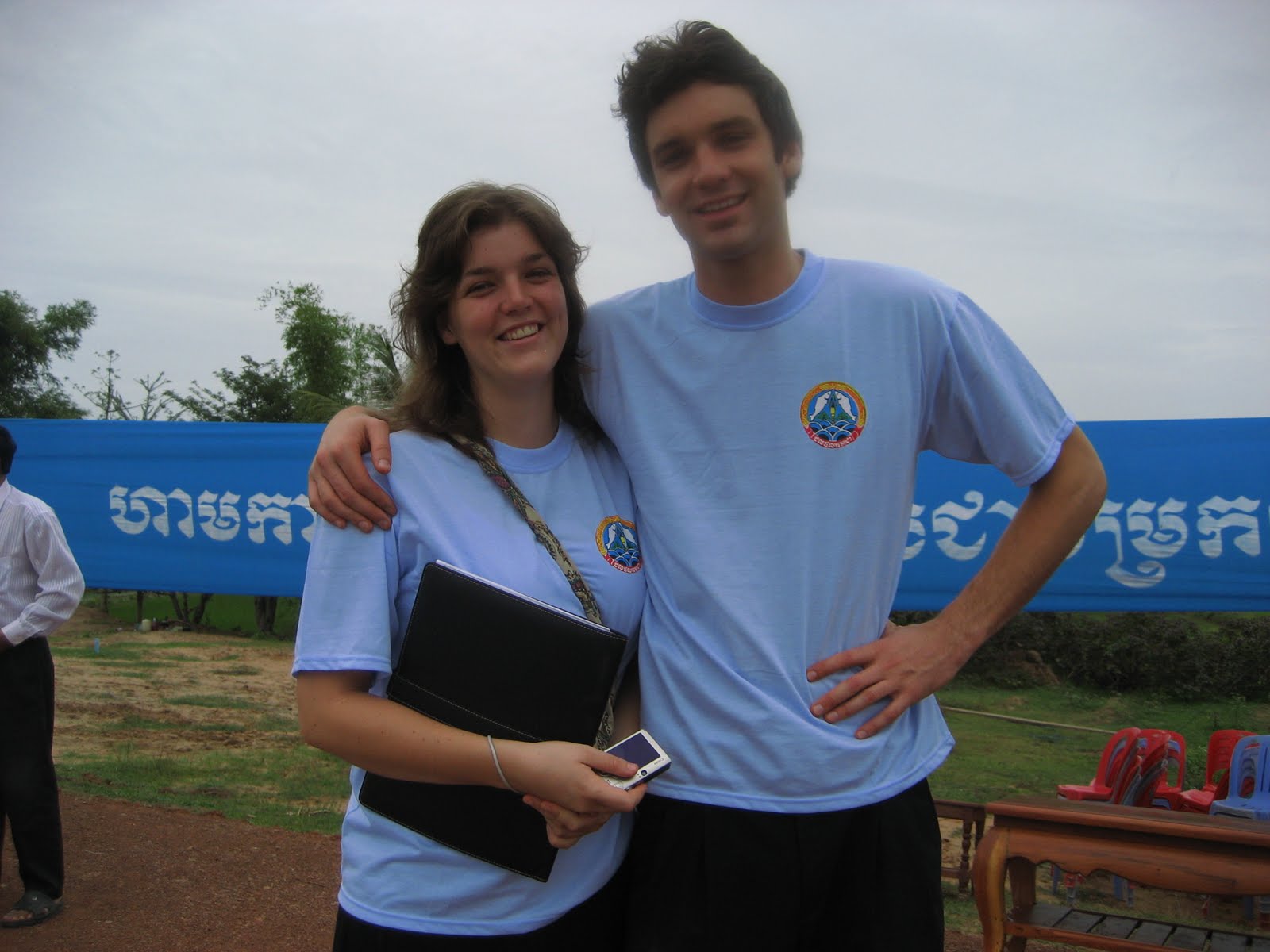
Arwen and Tobias at Reservoir Stocking Ceremony
I've been working a lot with Tobias on developing the new Human Translation website, and my favorite part of it is the photo record of the Trav Kod water gate.  There's several hundred photos up now in albums at www.humantranslation.org/media.html .  Scroll down past the video, and you'll see the albums laid out. These photos were taken during and after the building of the dam.

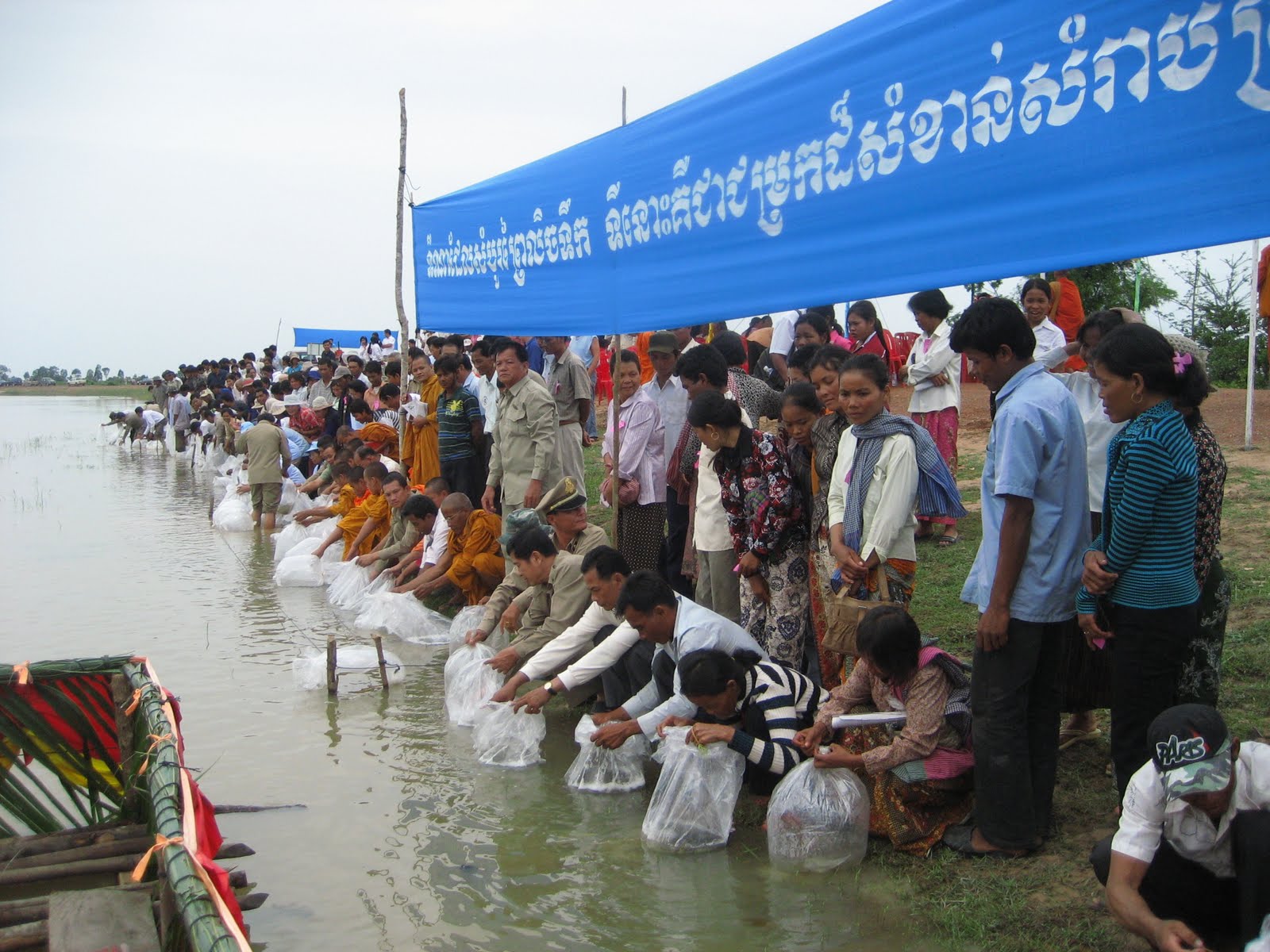
Releasing the Protein
My favorite album, at the moment, is the last one that is entitled "Stocking Trav Kod Reservoir Ceremony" which occurred in July of last year.  You'll see the reservoir, and the hundreds of locals who showed up to release fish and frogs into this reservoir.  Click on the album picture, and you'll be walked through a slide show of the ceremony.

This was a great project that is still on-going.  I'm hoping that Tobias will put up some news in the blog about what's going on at the offices of HT really soon.  There's a lot of news, but I'm not at liberty to report it. (Mum is the word).  But look at the About page (www.humantranslation.org/about.html) and click on the Partners link.

Lot's of surprises in store.

Meanwhile, Merry Christmas to you all.

Monday, December 13, 2010

Met Sin at theTrav Kod Reservoir

In June of 2008 I toured the rural community of Balang, Cambodia, inspecting a reservoir dam that had recently been constructed by Human Translation and Engineers Without Borders.  As noon approached, the Buddhist monk who traveled with us, Mean So Meth, needed to eat as prescribed by his order, so we approached an elderly man who was shaping a timber under a tree with a hand adz.  His name is Met Sin. 
 
Met Sin stopped his work, greeted So Meth with a respectful prostration, laid out reed mats for us, and joined us with four of his grandchildren.  When he learned that I was the father of the man he had come to know through Human Translation, he became curious.  He inquired of my age and we discovered we were both approximately the same age.  He inquired about my health, as he was obviously proud his own good health. He inquired about my grandchildren, as he was proudly supervising four of his own grandchildren. How many did he have? I asked.  He couldn't say for certain.

My son sat beside me, acting as translator, as well as my wife – whom Met Sin respectfully ignored. His youngest grandchild looked to be about two – precisely the age of our own youngest grandchild – standing naked before us while his sister cleaned him off with the water from our water bottle. 

I'd seen several hundred photos of Met Sin's grandchildren through the HT website, so I immediately felt attached to them in a special way: Beautiful children, each with a unique, individual curiosity.

As the monk finished his meal, he got out a piece of paper and began drawing on it, showing it show Met Sin.  My son explained that the monk was demonstrating how voting worked because the historic second national election in Cambodia was coming up.  Met Sin, my son explained, was illiterate and had never voted, and the concept of voting was new to him. His grandchildren listened and watched the exchange with intense attention.
Later I reflected on the parallels between our lives: our ages, our good health, our grandchildren, etc. We both lived in rural, agricultural communities of precisely the same size. He had been rice farming for subsistence in Balang while I had been working in the Napa Valley for wineries and grape growers.  His children might have been my children; his grandchildren might have been my grandchildren; his small house might have been the same house where I had lived for the past 25 years.

Met Sin was even preparing to vote, as we in the U.S. were preparing to vote in our Presidential election. 

But then I reflected on the differences between our histories: Met Sin had lived through Cambodian independence, the reign of the Khmer Rouge, the Killing Fields, the imprisonment of the entire population on  forced labor communes, and the recent Civil War that had left his land riddled with land mines and unexploded munitions.  And yet, when the Civil War was over, he had returned to his ancestral land at the side of this reservoir -- ruined and now rebuilt by Human Translation, EWB, and the community.  He is a survivor.

In 2009 we returned to the Trav Kod Reservoir, and I'd hoped to see Met Sin again.  He was away, working, but we met his wife who showed us the new fish pond where she was raising catfish - another community project sponsored by HT and it's local Community Translation organization.  The little pond was a plastic-lined hole that had been dug beside their hut, and she proudly showed us how they fed the fish with the special fish food that HT had provided.  It seemed like a small thing to my eyes -- a hole in the ground -- yet it's an important addition to their resources: A source of reliable protean. And if there is extra, they can sell the fish for cash.

The reservoir itself was full.  The Army had improved the road and ox carts were crossing the water gate with loads of rice straw.  Children slept in the carts on top of the straw as the caravan moved slowly towards the village.  The previous year I'd seen ox carts carrying wood scavenged from the forests surrounding Kulen Mountain.  At the time, I'd thought that the carts filled with wood was picturesque, until I realized how quickly the land was being denuded of forest.  This site of the rice straw seemed like another small improvement: One that was less severe to the ecology.

I took this photo of the reservoir and one of the current HT team right before my camera's battery failed.  HT had come a long way, and Met Sin's family had come a long way in a few short years. 

When Tobias had first come home from Cambodia on his first trip -- committed to helping the community at Balang rebuild the reservoir -- I was as skeptical as the next person.  But it had come together -- as it still is coming together -- and it makes me proud to know him and his work.  Proud as a father, but also simply proud of another human being.

This Feb and March Judith and I will be returning to S.E. Asia, and I hope to be able to travel out again to meet Met Sin and see how his extended family is growing up.  He's had the pleasure of seeing my family -- at least Arwen and Tobias -- mature these past six years.  I want to see how his grandchildren are fairing too.

Saturday, September 25, 2010

Two Years of Change After the Train Wreck

How can I get you to vote in the next couple of weeks.

You've heard the reports: The Republicans are counting on a mid-term landslide to return their candidates to Congress.  They're counting on the frustration of voters of a growing but still small conservative constituency to be so outrageous and noisy -- promulgating lies and innuendo -- that voters who supported Obama's election two years ago will lose heart and stay at home.

I find this tactic really annoying, and it's making me mad.  Really! This is the party that screwed us, and now they're trying to get back in power.

But maybe I'm being too harsh on the Republicans.  Is that possible?

So I started doing a little research on the history of Republican actions -- using their words and reports -- to see if maybe I'm just being too partisan.

I wanted to see if maybe I missed something that might change my mind.

The following clips are -- except the last one -- I found on YouTube.  What I found might help you decide to get out and vote.

The Warnings in 2006

In 2006 -- after six years of Bush-era economics -- economist Peter Schiff was warning that we were heading for a massive recession.  But it wasn't the message that the US wanted to hear.  In fact, Bush economists were telling us that everything was hunky-dory.  Listen to this debate. It's amazing how the two world views diverge: One listing out the reasons for concern, and the other pooh-poohing those concerns. It was a heated debate, so the piece is long.  But watch it.  If you memory of that time is a little flakey, this will bring it back into focus.


My view in 2006
So what was my personal response to the dire warnings that the housing bubble was going to kill the economy?  Like every good American, I listened to the Bush economists, and I went out an spent more!  We bought a second house, and piled on more debt.  It was a nice house, and it helped us out at the time.  But as the housing bubble started to collapse, it became harder and harder to find a buyer for it when we needed to sell.  Fortunately, on a bright day in September of 2008, it finally sold way below what we paid for it.  Our teeth gritted, we lost at least $20,000 on the sale.  But the day the papers closed, we didn't realize how lucky we were.  Why?

The Meltdown Melts Down

Because the very next day Lehmann Brothers collapsed.  And the Dow Jones Industrial Average took one of the biggest nose-dives in history, dropping well over 400 points on a single day.

Remember that day, in September of 2008?


Goodness! But isn't Henry Paulson watching this?  Aren't the Republicans concerned?  Well here is Hank Paulson's response to the crisis:


"It's Not Our Fault"

So it wasn't their fault. It was, according to Paulson, because he couldn't go to Congress -- then in the hands of the Democrats -- to ask for help.

And yet, a few weeks later, that's exactly what Paulson and Bush did. And then Bush explained this thing called TARP to the nation.

Below is the entire address to the nation that Bush gave to us.  In it, he details not only what's going on, but how we got to that state of chaos, and what they were planning to do about it.

Watching this clip is really kind of sad, because for the first time, it seems, Bush actually seems to take some interest in the economy and the real lives of Americans. 


But wait, isn't Bush's address right out of Peter Schiff's portfolio?  Didn't he say the same things?

Well, yeah. His economic policy of "no-regulation" created an environment by which the entire financial structure of the US was threatened.  Everybody -- from Wall Street to Main Street -- was suddenly about to go down the drain.  So they had to act, and they intended to act swiftly. 

The TARP: The Fed to Save Us All!

Bush and Paulson made us a pledge: The troubled assets would be purchased from the banks by the U.S. Govt, and the Govt would hold onto them until their value rose, at which time they would be resold at a profit.

Sounds good, doesn't it? Crisis averted? Right?

Well, not exactly.  Just a few weeks later, Paulson changed the rules: Instead of actually buying the failing assets -- the mortgage backed securities -- the Govt would simply buy the banks for a period of time, letting the banks keep the assets on their books.  This would let the banks reap the benefits of any upward shift in the housing market, and later -- ideally with the money they gained from those sales -- they would buy back their businesses from the Govt.

Nationalizing the Banks -- The real bailout.

But wait! Isn't that the bailout that Bush said he wouldn't support?  Isn't that "Nationalizing" the banks themselves. Well, yeah.  Sort of.  Except the Govt. wouldn't buy all the banks.  In fact, it just meant that the Govt was going to bail out Wall Street.

And when asked about this, Paulson had this to say:


Before Obama
All this happened before Obama even took office. And if you're a conspiracy theorist, you might conclude that the Republicans -- knowing that the Democrats were going to win the election in 2008 -- decided to trash the country's finances so badly that nobody could fix it before the 2010 elections.  (Personally, I don't think that even the Republicans could be that diabolical, but there are some people out there who do.) 

So what did the country look like before Obama was sworn in? The following video, made in October of 2008, tells the story:


What the Republican's Help For America

Obama inherited a three trillion dollars budget deficit when he was sworn in.  The country was mired in two wars. The economy was on life-support.  The unemployment situation was (and is) devastating households, while Health Care costs were rising at a such a rate that 17% of the population had no insurance coverage.  Moreover, the infrastructure of the nation -- both physical and educational -- had been allowed to deteriorate to its worse condition since the 1930s.  


Normally, one would think that both legislators from political parties would see the challenges facing the country, roll up their sleeves, and go to work.  

But it didn't work that way.  Here's a political video purportedly representing where the Republicans were at in  March of 2009:


What the Democrats Did.

So, with no help from Republicans, what did the Democrats accomplish in the two years since Obama was elected?

Here's an abbreviated list of laws signed, aimed at rebuilding the U.S.

We still have a long way to go -- especially with unemployment at record percentages.  But there's been a sincere effort to rebuild the U.S., and considering the size of the hole that was dug by Republicans, we've made some real progress.

The idea of returning Republicans to power in either the House or the Senate is madness.  But that's what they're selling.

We have to get out and vote.
It's easy to see we're still on the way out of this mess.  It's easy to mistake progress in this atmosphere of lies and innuendo as no progress at all. 

But please consider where we've been, and how far we still have to go.  We're coming through a valley of despair right now and it's hard work.  But we're headed in the right direction.

Maybe you don't like Obama. 

Maybe the Bush years look really romantic, with all the money we were borrowing, and all the junk we were buying.

Maybe the Republican ideology has its attractions.

But the idea that a nation without government or a nation with a government of business hedonists will be our salvation is crazy!  And that's crap Republicans is serving.

It's really important to vote, to keep the momentum going.

The Daily Show With Jon StewartMon - Thurs 11p / 10c
Postcards From the Pledge
www.thedailyshow.com
Daily Show Full EpisodesPolitical HumorTea Party

Monday, July 26, 2010

A Facebook Page for Duch - Kaing Guek Eav

Kaing Guek Eav (Duch) is an assassin. He oversaw the detention, torture, cruel death of an estimated 14000 Khmer citizens.  Today his sentence for the crimes he committed equates to less than one day for every 2 people he murdered.  

Anyone who has visited the Tuol Sleng prison knows that this sentence is a travesty. 

Tuol Sleng was originally a public school in  Phnom Penh.


After the Khmer Rouge victory in April 1975 Duch and his men set up prisons throughout the capital including the infamous Tuol Sleng prison.  As the party purges increased towards the end of the Democratic Kampuchea period, more and more people were brought to Duch, including many former colleagues including his predecessor at Tuol Sleng, In Lon. Throughout this period Duch built up a large archive of prison records, mug shots and extracted "confessions".
The routine was atrocious. Any person who fell under suspicion within Democratic Kampuchea was sent to Tuol Sleng.  Suspicion was enough to send you there.  Once at Tuol Sleng, you were photographed and sent through a serious of interrogations that always included torture.  The purpose of these interrogations was to get more names of individuals who were suspicious.  This included relations, children, acquaintances, anyone. If you survived the torture, you were taken out to a ditch, and a hoe was embedded in the back of your skull. Your body was thrown into a mass grave.

14000 people suffered through this routine. 

How do you imagine the impact today?  Think about these:
  • If you came under suspicion today, you would never see your family again.
  • You would be tortured daily until you gave up the names of every person you have ever known.
    • If you had a baby with you, it too would die.
    • Your parents, brothers, sisters, aunts, uncles, cousins would be implicated.
  • You would end up providing these names in full knowledge that they would be following you to this end.
  • Eventually, the torture would overwhelm you and there would be nothing that you could recall.
  • Then you would be led out to a field where you would dig your own grave, be told to kneel down, and your end would come.
So I created a Facebook Page for Kaing Guek Eav.

This is it:

Saturday, July 24, 2010

Daniel Schorr, I'll miss you....

Daniel Schorr passed away yesterday and already I miss him.  He was the feisty, principled journalist who was number 17 on Richard Nixon's famous enemies list.  In fact, he was the reporter who revealed that such a list actually existed, and I imagine his surprise and pride at discovering his name on it.

He literally worked his way up through the ranks of broadcast journalism from the ground floor, starting by sending in tips to a local newspaper at the age of 15.  Then he worked his way down through the same industry to end his career broadcasting on NPR.  His concerns were my concerns -- as a citizen and a student of American politics.

His sonorous voice on TV or radio tended to sound professorial as he grew older, but he earned my respect as a viewer and a listener year after year.  As I learned to listen to him over so many years (and one had to really learn to listen) he became, for me, a kind of extension of the voice of Edward R. Murrow -- the extension of the idea that a primary role of journalism is to speak truth to power.

I was listening in my car to his last broadcast on NPR, just a few weeks ago, wondering how much longer I would hear his voice. I found myself stopped at the intersection, saying to myself "Thank God NPR is keeping his voice alive  after he was driven off of broadcast TV." His commentary was as strong on the last broadcast as it had always been. Only Bill Moyers today garners a similar respect from me, and right now Moyers too has gone off the airwaves. 

Schorr's contribution to journalism is difficult to understand in the current climate of corporate broadcasting and the daily Internet news cycle.  He was not particularly photogenic. His voice had a slightly unnerving quality about it.  He was not funny -- rather a bit erudite.  But his commentary provided context, knowledge, and insight -- and not a small amount of wisdom -- as he laid out his perspective on current events.  He seemed to muse about what was happening, sometimes awestruck that his craft had sunk to such depths of frivolous nattering. When so much was at stake for humanity, how can shows like Entertainment News and the Daily Show represent the heart of reporting today?

He reminded us that there is a kind of insanity in the reporting of current events today that too often propels personality demagoguery in journalism.  He was not of that school: Indeed, he seemed to go against that grain.  His reporting and commentary demonstrated that journalism should be more about substance than style; that news anchors and reporters should actually think about what is being said before they open their mouths or read a prepared script.  His instincts were often right: We're living in an age of propaganda now, and not an age of information delivered through news broadcasts. But sometimes he was wrong, and we took him for a honest person, fooled like the rest of us, by the twists and turns of history.

If there were truly an enemy of the Conservative Right, Schorr seemed willing and capable of taking on the role, without bowing to mud-slinging.  When something was wrong -- as is so often the case -- Schorr looked for the historical angle to describe it, and then constructed an argument, often nuanced and detailed, to cut it down to its bone.  But the Progressives couldn't take him for granted either. If he disagreed, they were warned that trouble was in the offing. His commentaries on the Obama Administration were filled with such warnings.  His continual critiques of the Clinton Administration were also usually on the mark.

But most of all, it was a sense that he couldn't be bought or co-opted.  I think that's why radio and NPR became his final formats for expressing himself: Corporate sponsors could no longer reach him; Politicians could not intimidate him.  They couldn't influence his words.  Instead, they chose to try to marginalize what he was saying, believing no one really cared any more.


I cared.


I will miss Daniel Schorr.  His voice was the voice that glued a past excellence in journalism to its present sad state, and I -- as a writer working in a completely different realm -- admired him.  I admired his detailed reporting, his thoughtful commentary, and his feisty sense of right and wrong.

More importantly to me, I admired his courage to speak truth to power.